
Psychology and sport: the quiet eye theory

An athlete’s ability to concentrate (or lack thereof) during a performance, which often makes the difference in the final result, has been a constant subject of investigation. This led University of Calgary researcher Joan Vickers to develop the now-famous QUIET EYE theory: the “calm eye.” This is defined as the final gaze fixation on a target object before performing a direct action, acting as a crucial factor for movement precision.
Training the Q.E. provides numerous benefits:
- Increases precision and control of aiming/targeting movements.
- Improves the sense of control (control beliefs).
- Reduces performance anxiety and increases the athlete’s overall psychological well-being.
Practicing Q.E. therefore allows for consistent improvement in sports performance.
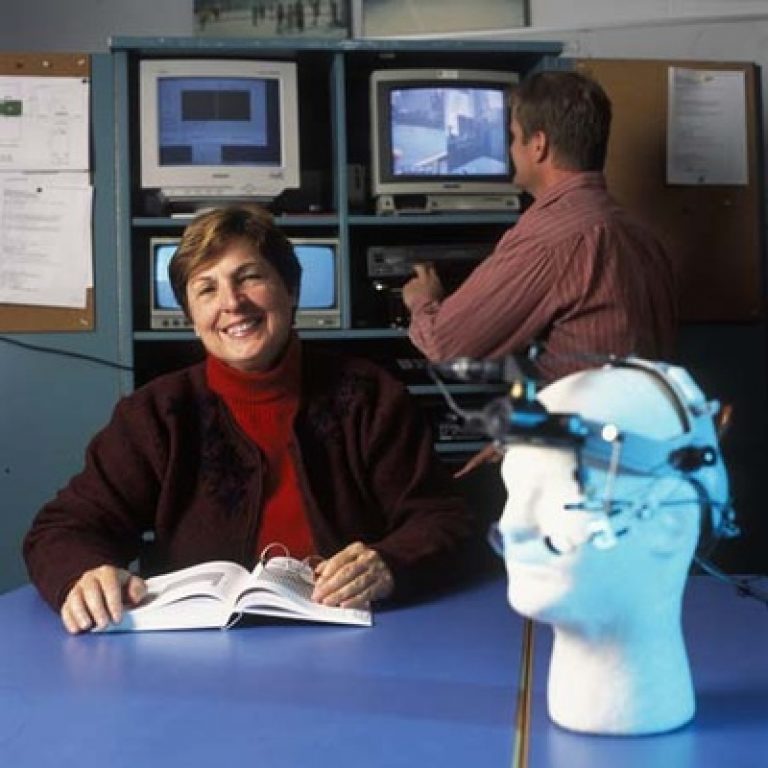
Professor Joan Vickers of the University of Calgary
Characteristics of the Quiet Eye
- It is directed at an object or location critical to the action space.
- Its onset occurs before the final movement.
- Its duration is longer for expert athletes, for more complex tasks, and for successful actions (a shorter Q.E., conversely, decreases action accuracy regardless of the skill level!).
- It is stable, confirming the need for an optimal focus on a single object/location prior to the final action.
…and it is trainable!
How do you train the Quiet Eye?
By teaching how to align the gaze with the intended target, ensuring that focus and aim are maintained on it for as long as possible.
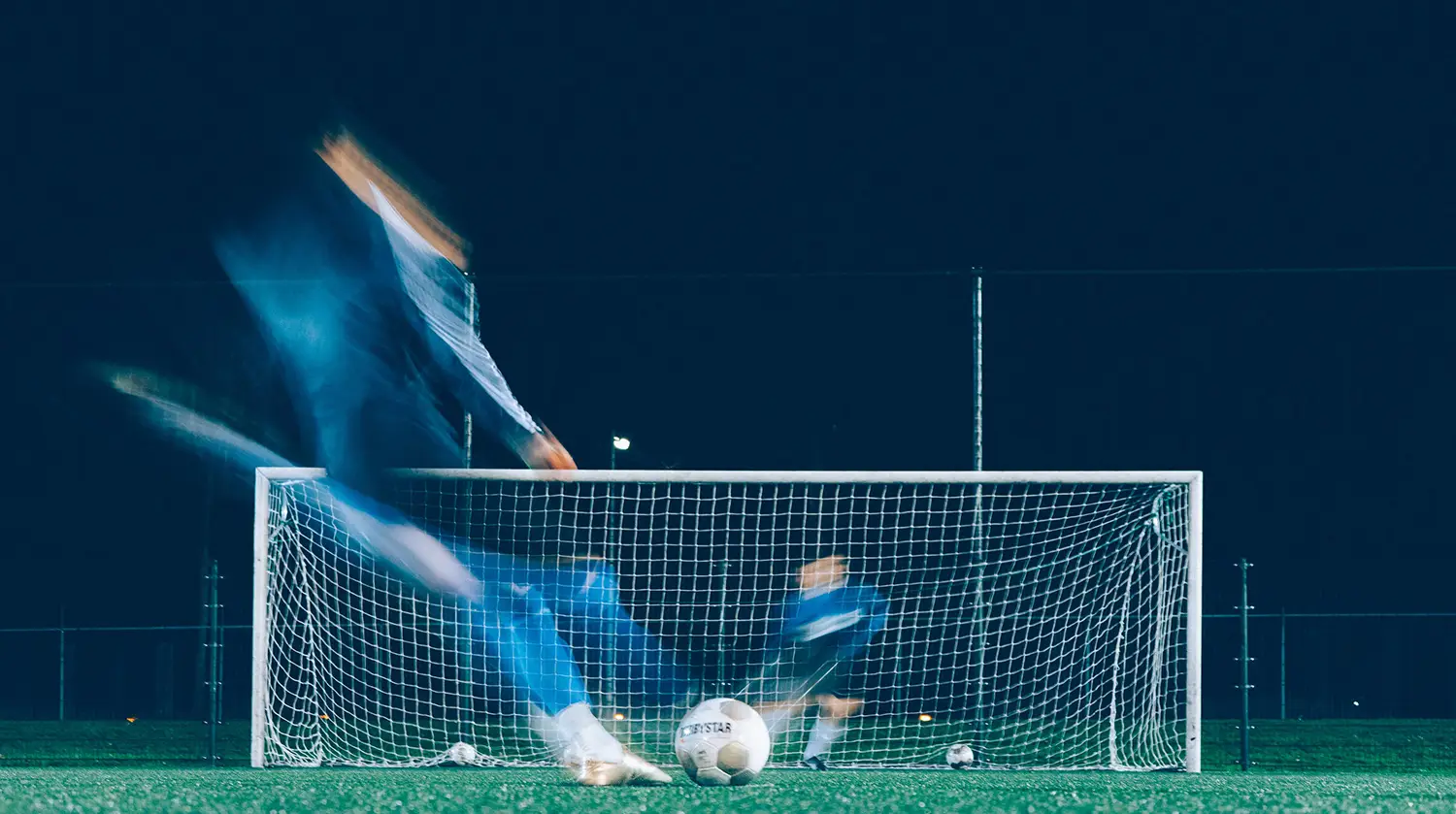
Study example on penalty kicks (Wood & Wilson, 2012)
scenario
Results were compared between a traditional training group VS a Q.E. training group.
In this case, the points to be fixated upon are those where it is easiest to score: the two upper corners of the goal. These are numbered 1 and 2, and participants are asked to call out the number of the chosen target just before they start running toward the ball to kick it.
In this way, it is certain that the subject has fixated on the target for at least 1 second, sufficient time to pre-program the shot.
Results
The Q.E. training group showed improvements in both performance and perceived control:
- A decrease in the feeling of outcome uncertainty.
- An increase in the perceived ability to handle pressure.
- The correlation between perceived control and performance effectiveness became clear.
Examples of studies on martial arts and combat sports (Ripoll et al. 1995; Williams, Elliott 1999)
In the study of Q.E. within martial arts, a correlation between expertise and visual search strategies has long been established: more expert fighters fixate on a single point because this helps optimize peripheral vision, which is crucial for anticipating opponent movements (novices have a more varied visual search path, ranging from the centerline to more peripheral areas).
The fixation point depends on the discipline (kickboxing/kung fu: head/upper body; taekwondo: lower body). Finally, anxiety has a significant effect on visual search; a higher number of fixations has been noted in more anxious (and novice) athletes.
Want to know more? Contact us