



Today, the issue of road safety is considered a matter of primary importance worldwide. The trend over the last twenty years has been the creation, first by individual countries and then at a global level, of multi-year strategies characterized by a combination of both regulatory and infrastructural interventions, aimed at increasing safety and reducing the number of deaths and injuries on the roads.
According to the GLOBAL STATUS REPORT ON ROAD SAFETY 2018 by the World Health Organization, road accidents represent the eighth leading cause of death globally. The figures are staggering: over 1.35 million deaths each year and 50 million injuries.
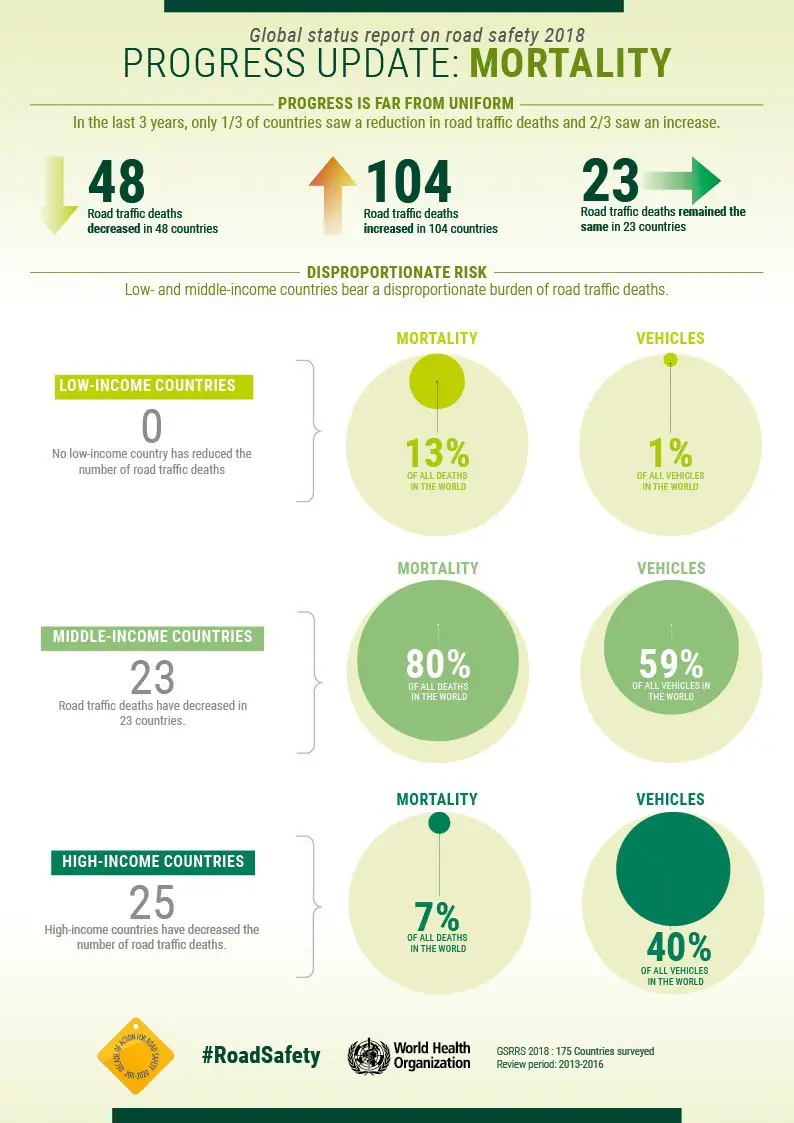
Image: World Health Organization.
The goal of zero casualties
In 1997, the Swedish Parliament approved a plan called VISION ZERO, which aimed to eliminate deaths from road accidents by 2020. This project, which proved to be truly effective in Sweden, has expanded over the years to practically the entire EU and has also been adopted by some American states and in the East. The goal of zero deaths has been moved to 2050.
A complex system of interventions on infrastructure, national laws, and local regulations, the toughening of penalties, the coordination of emergency services, and economic incentives to combat vehicle obsolescence has led to significant results worldwide.
Tests to evaluate attention and interaction with vehicles and during driving also naturally have their importance and are systematically adopted by all car manufacturers.
Experiments to evaluate driving attentiveness and responsiveness through eye-tracking technology have already joined the classic tests conducted by car companies. In fact, eye tracking proves particularly effective for this type of activity because it measures the driver’s subjective reaction.
In other words, it is an objective examination of the human component involved in the driving process (beyond vehicles and infrastructure).
Here is a small test we conducted.
Want to know more? Contact us