
EEG and eye tracking applied to market research: how do they work?

When conducting market research, how is it possible to go beyond the “declared” and reach the point of detecting “unconscious” responses? We explain it simply, starting from the basics. Neurophysiological tools such as EEG and Eye-tracker allow for the evaluation of the consumer’s cognitive and emotional responses in front of a certain product and the prediction of their purchasing behavior (Rawnaque et al., 2020).
Which tools?
Each of these tools is specialized in collecting a certain type of information: for example, the eye-tracker allows us to analyze eye movement, while EEG analyzes some cognitive processes such as engagement, memorization, valence, and workload (for info I suggest you browse the Bitbrain website HERE).
Synchronization
In the use of these devices, one of the greatest difficulties that “insiders” encounter is their synchronization, i.e., the alignment of the acquisition times of a certain piece of data with respect to the presentation of the product under study or the start of a specific task. However, technology today comes to our aid and allows us to overcome even this limit! What you will see in the video below is the recording of an EEG measurement performed in sync with eye tracking.
The 4 traces on the right are some of the possible processes that can be detected through the EEG model we used (Diadem by Bitbrain), while the blue circle moving on the commercial is the eye movement we detected through the Tobii Pro-Nano eye-tracker.
So, as you can see, it is possible to synchronize these two devices.
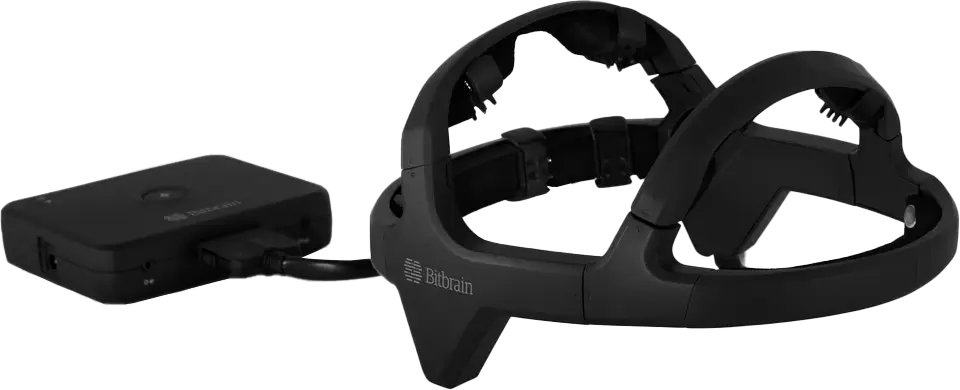
Bitbrain – Diadem helmet
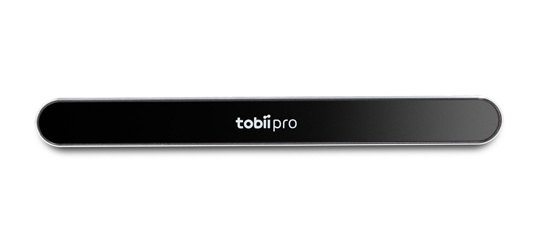
Eye tracker Tobii Pro Nano
Concretely, what advantages does synchronization bring us? What insights can we obtain from the joint use of these two tools?
The synchronization of the devices gives the possibility to correlate visual behavior with brain behavior more precisely. This allows us to state with greater precision and certainty that at a given moment the participants of our study manifested a series of specific behaviors.
Synchronization allows us to evaluate, for example, the way in which participants collect information, which they consider relevant and which they neglect, which factors capture their attention the most, and which mental states they generate. We can thus draw conclusions regarding the effectiveness of the commercial’s storytelling, its pleasantness, and memorability.
All this greatly affects the future behavior of the consumer in relation to the advertised product.
Want to know more? Contact us