

It is a scientific methodology that allows us to understand the intuitions of the human mind.
A person’s eyes are the gateway to their inner world, to the ways in which they gather information from the outside world, the methods by which they process it, and how it will influence their decisions and actions. The study of gaze is a field of analysis that originated in the 19th century and has continued to evolve until becoming, today, a work methodology of scientific rigor.
The eyes are one of the main tools we use to learn, acquire knowledge, document ourselves, and draw information from the reality that surrounds us, in such a way that we can make our decisions and carry out any choice.
Measuring and understanding visual attention precisely and objectively through eye-tracking techniques allows researchers and companies to study human behavior on a solid scientific basis.
What eye tracking does
Eye tracking (in Italian, oculometria) is, technically, a process that monitors eye movements to determine where a test subject is looking, what they are looking at, and for how long their gaze lingers on a specific point in space.
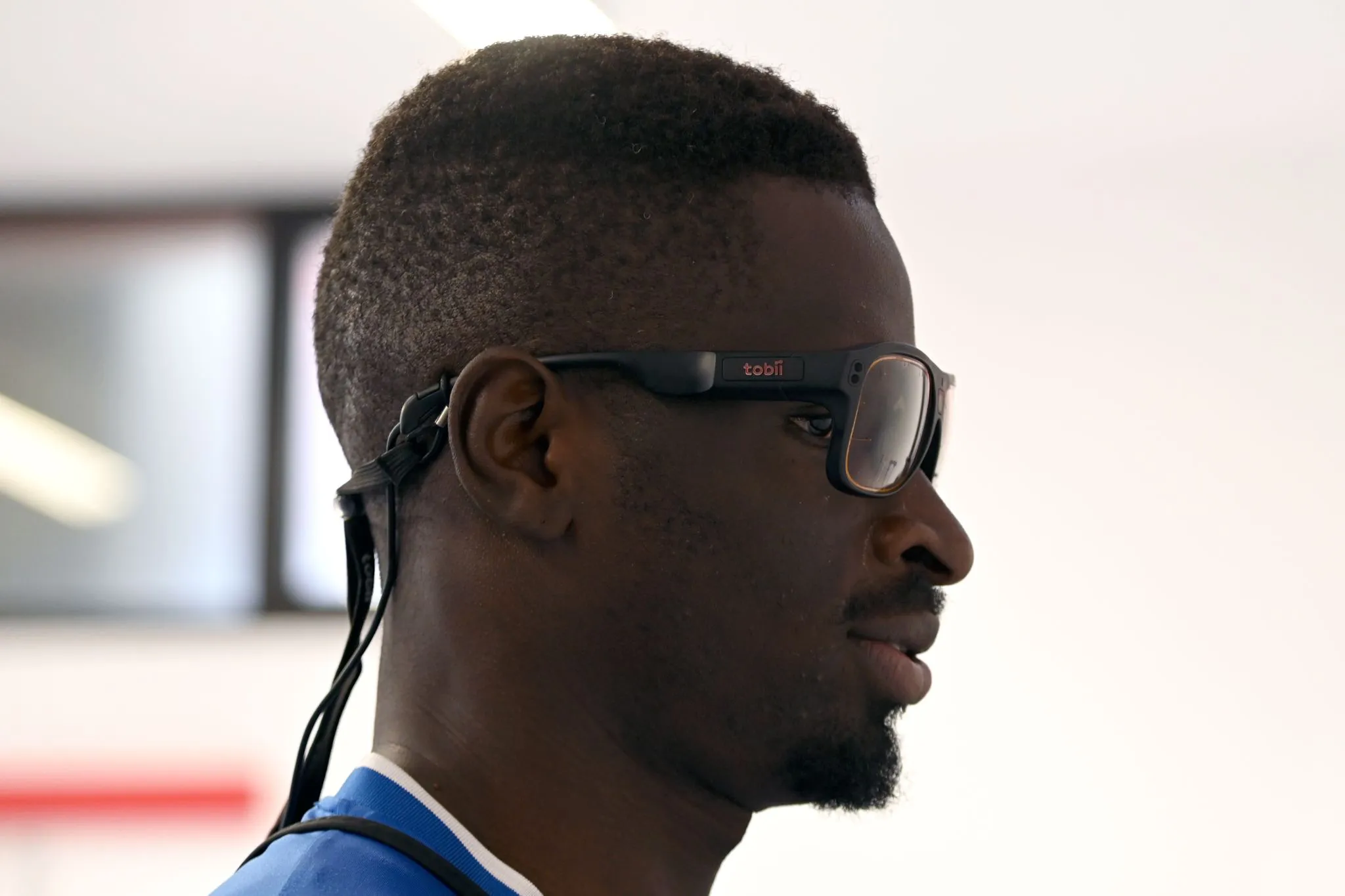
Eye tracking is a methodology of consolidated effectiveness, applicable to a multiplicity of contexts. The tracking of eye movements occurs through dedicated devices, and the detection/interpretation of the associated data is processed through specialized software, using different techniques.
pupil centre corneal reflection
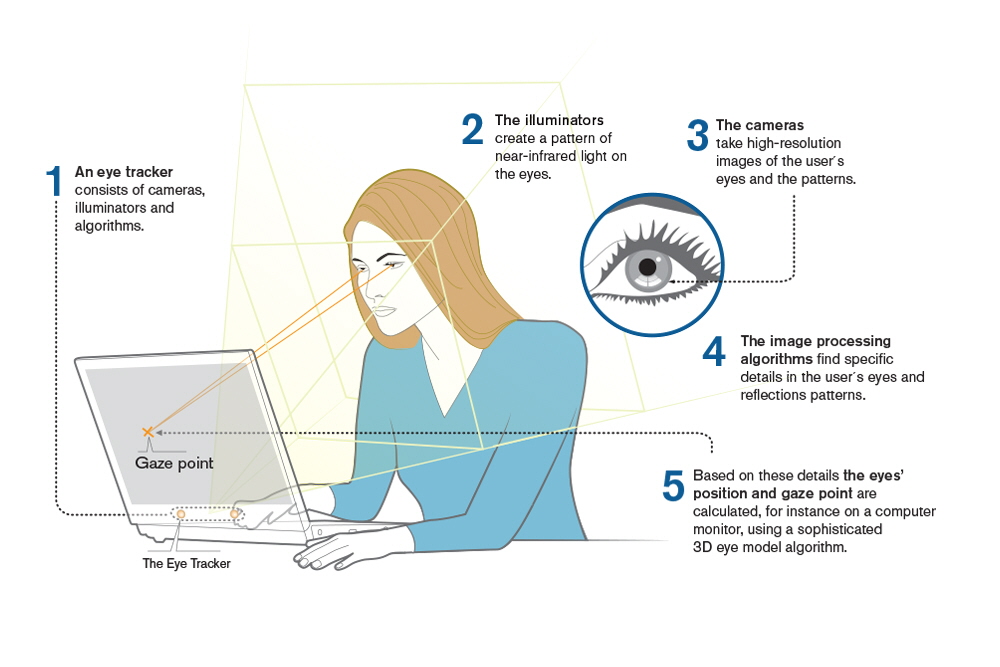
Image: ©Tobii
When it comes to remote and non-intrusive eye tracking, the most commonly used technique is Pupil Centre Corneal Reflection (PCCR), a US patent.
The basic concept of this methodology is to use a near-infrared light source to illuminate the eye, causing very clear reflections detectable in both the pupil and the cornea, which are then photographed by an infrared camera. The image allows for the identification of the light source’s reflection on the cornea (glint) and within the pupil.
The vector formed by the angle between the two reflections (on the cornea and in the pupil) is then calculated: the direction of this vector is used to compute the gaze direction.
Why Infrared?
An infrared light source is necessary because the accuracy of the gaze direction measurement depends on a clear demarcation (and detection) of the pupil, as well as the corneal reflection. Normal light sources (with standard video cameras) are unable to ensure maximum contrast; therefore, the detection would be much less accurate compared to infrared.
Light from the visible spectrum is susceptible to generating uncontrolled specular reflections, whereas infrared light allows for precise differentiation between the pupil and the iris (when light enters the pupil directly, it simply “bounces” off the iris). Furthermore, since infrared light is invisible to humans, it does not cause any distraction while the eyes are being monitored.
Want to know more? Contact us