

Eye tracking and psychology of art

Eye tracking and methodologies related to Neuroscience are increasingly used to deepen the perception of a work of art by its viewer.
In this regard, let us add another contribution: we are very happy to have supported Miriam Mirolla, Luigi Pagliarini, and Ludovica Aloia in this work of theirs.
The experimentation took place at the Auditorium Parco della Musica in Rome during the exhibition “Sergio Lombardo. Quilting. Nuove composizioni stocastiche “.
Below is an excerpt of the study. Happy reading!
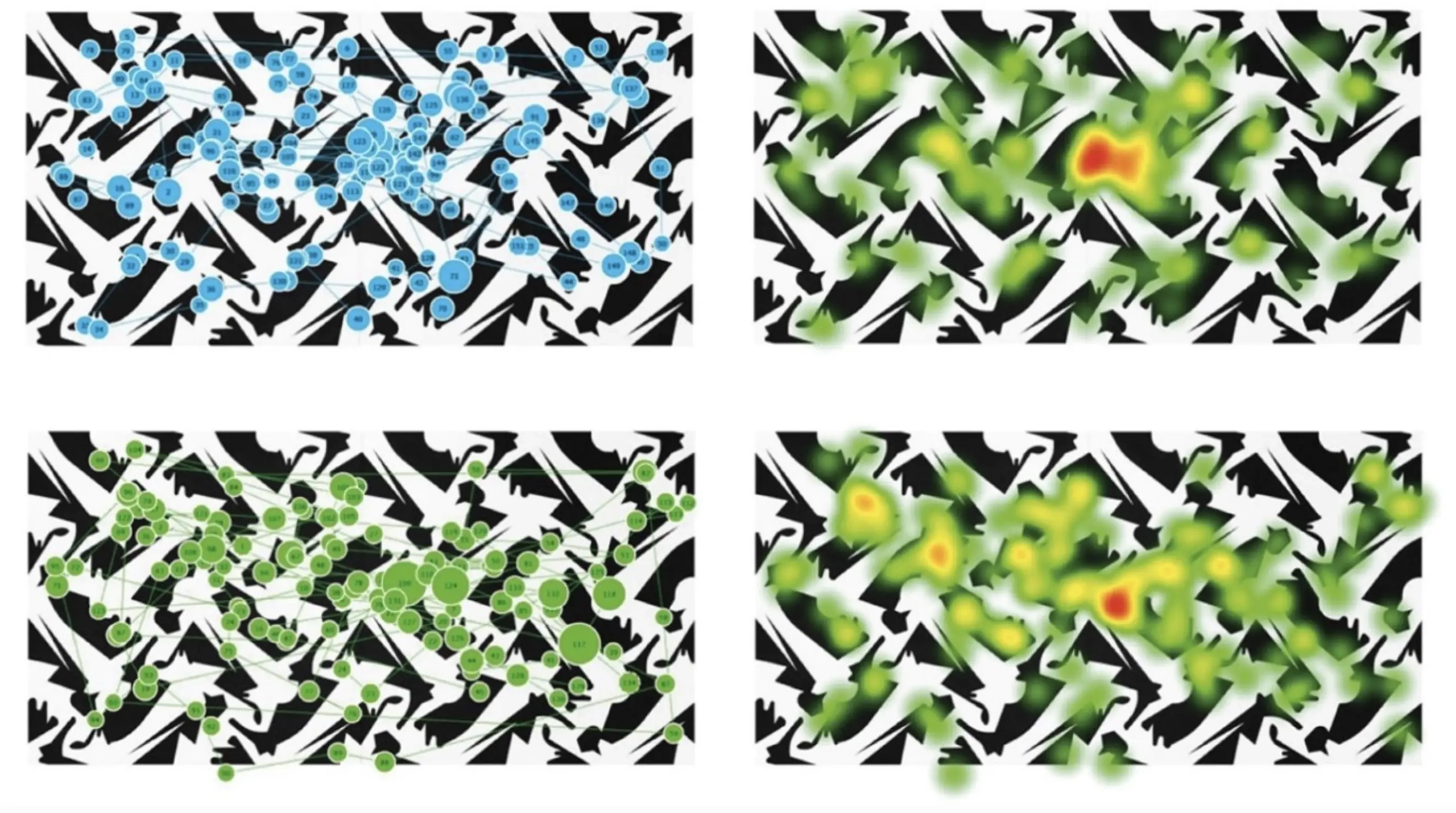
“It has long been demonstrated that some random structures are capable of favoring the projective perception of meaningful images, triggering strong emotional charges in the perceiver (Lombardo, 1983). It is equally well known that hyper-ambiguous stimuli of greater complexity are aesthetically preferable and decay more slowly than less complex hyper-ambiguous stimuli (Lombardo, 1991). In a subsequent investigation dedicated to the Eye-tracking exploration of a stochastic image by Sergio Lombardo (Mirolla, 2015), the visual and interpretative strategies of the perceiving subjects were also highlighted through highly individualized oculokinetograms and maximally creative verbal interpretations.
This research therefore falls within the path of long experimentation on the reception of Sergio Lombardo’s Stochastic Painting. It proposes some elements of novelty: first of all, the desire to keep together the administration in digital format of the stimuli and the ecological vision of the original works, i.e., the six stochastic paintings located in the Foyer of the Auditorium, visible in all their majestic beauty. Furthermore, with the joint use of Eye-tracking and Muse band, it was possible to synchronize the oculokinetograms with the brain wave graphs and compare them with the relative verbal descriptions.[…]”
Want to know more? Contact us